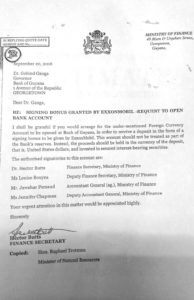
Even as the furore over a US$18 million signing bonus the Government received continues, ExxonMobil has distanced itself from Government’s decision to use the money to pay legal fees. While it acknowledged paying the money into the Bank of Guyana account, its input in the process ended there.
According to Exxon’s Senior Director of Public and Government Affairs, Kimberly Brasington, the company followed, and will continue to follow, local laws and regulations it encounters. She noted that while the transaction was a normal one, Exxon did not have a say in Government deciding to use the money for legal fees in Guyana’s border controversy.

“ExxonMobil is committed to the highest standards of business conduct, and we follow all local laws and regulations wherever we operate. A payment was made as a signature bonus to a bank account within the Bank of Guyana, which is owned by the Government as designated in writing by the (Ministry) of Finance.”
“It is common for payments to take place at key stages in the execution of contracts and development of resources. A signatory bonus is a customary and normal part of petroleum agreements. As a commercial entity, ExxonMobil does not have a role in how a sovereign country allocates its revenues,” Brasington explained.
She noted that transparency should apply to all contracts rather than selective contracts. But Brasington also acknowledged the need to protect commercially sensitive and proprietary information, as well as to not violate host government laws or contractual obligations.
Guyana, which had a long-standing agreement with ExxonMobil, renegotiated that agreement after the company’s 2015 oil find in the Stabroek block. In May of that year, Exxon confirmed that more than 295 feet of high-quality oil-bearing sandstone reservoirs were encountered at its Liza 1 exploration well.