
Background
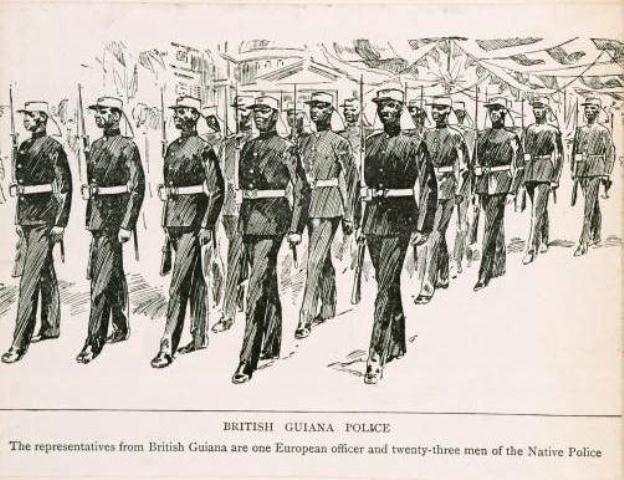
We can begin to appreciate the pivotal role of the Police Force – which is today the most visible and ubiquitous symbol of the state – when we consider that this institution typically, has the sole authority to use force against the citizens of a country.
The Indians that were brought to Guyana starting in 1838 have a history that is almost coterminous with that of the GPF, which was founded in 1839. Both events were in response to the abolition of slavery in 1834, and just a decade after the launching of the London Police Force. The British Police was unarmed, up to the present, and their emphasis was to protect British citizenry. In their definition of the duty of the police “to maintain law and order”, their imperative was to uphold the law.
The British view of the role of the police in its colonies however, was the opposite of the above stance. Here, their prime concern was to maintain order to protect British interests, and they organized the police force appropriately.
They followed innovations in the Royal Irish Constabulary – to ensure the imposition of order against the predominantly Catholic population. It was very centralized, heavily armed and ‘ethnicized’. That is, it consisted mostly of those the British could trust – Irish Protestants and English officers; the focus of the Irish police was to maintain order, i. e. to protect the security of the state.
The GPF was explicitly organised in Irish tradition. The GPF therefore had always been heavily militarised, but as the protests by Indians on the sugar plantations intensified, in 1889 the force was reorganised and its structure and training methods made more explicitly military. This was in the era of the greatest numbers of Indian immigration.
In 1891, with the departure of the West India Regiment, the entire police force was armed and became a semi military outfit.
Divide and Rule: Exclusion of Indians from the GPF
It is noteworthy that the motto, “To Serve and Protect” was not adopted until more than a hundred years after the formation of the GPF. The British were certainly not moved to serve and protect the newly-freed slaves. The early police recruits were primarily from Barbados to ensure that any orders from the whites to use force on the newly freed slaves might not be disobeyed, out of sympathy for “kith and kin”. The GPF was organized with a highly centralized command structure to deal with anticipated uprisings from the local Africans. The British had honed its “divide and rule” policy to a ‘T’. When the ex-slaves proved compliant to the new order, and indentured labourers were brought in to replace them on the plantations, the latter were determined to be posing a threat, purportedly because of the implements (cutlasses) in their possession. By the 1870s, Governor Kortright noted that there were more than 60,000 Indians on the plantations – with cutlasses in their hands – and this presented a clear and present danger of an uprising. Armed police were recommended for the rural areas.
Of course, it was an implicit acknowledgement that the abysmal conditions and atrocious pay would provoke the Indians to rebel. The police force was expanded, especially in the rural areas, to counter the Indian “threat”. The estimates for the GPF reflect the inexorable build up: 1850 – $ 19,000, 1868 – $ 33,500, 1879 – $ 80,000. In 1881, the governor repeated the official apprehension.
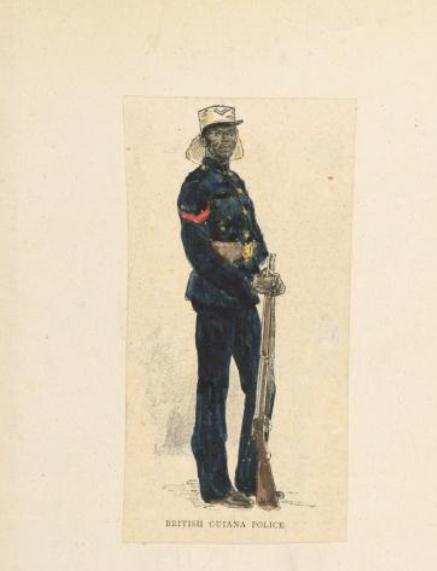
The interests of the planters, as they defined their security needs, were made coincident with the security needs of the country. The converse, of course, also held: the Indians on the plantations represented a threat to the nation.
The local Africans were soon recruited into the GPF to deal with the new “threat”, and set into motion a historical discrimination against Indian recruitment that continues to the present.
It suited British policy of playing off one ethnic group against others, to have a segregated force. There was never a problem with Indians unsuitable, per se, for serving in the police or any other militarized forces.
The British army and police in India at no time had more than 5 per cent British members – they were all staffed by Indians.
The British were old hands at the art of discrimination and they used various stratagems to exclude Indians from the GPF. In Guyana, “minimum physical requirements” was one of their prime tools. The physical requirements for males were as follows: Height: 5’ 8″, Weight: 135 lbs., Chest: 34″. During the nineteenth century, the average height of the Indian male was about 5’ 3″ and so in one swipe, most Indians were excluded.
The age requirement was 18-25 years, and the applicant was required to be unmarried.
Up to the middle of the 20th century, however, Indian cultural practices ensured that most males were married by that age.
Food, which was geared for the tastes and diet of the Africans, was another barrier to Indians, who had religious proscriptions against certain foods.
Breakfast was typically tea and bread, while lunch and dinner leaned heavily on ground provisions, (plantains, yams, eddoes – fried and in soups) beef, pork, salt fish. Muslims of course, did not eat pork while Hindus ate neither beef nor pork.
These physical factors, which were supposedly facially neutral and not changed until 1968, and the food, were not modified until after 2000. Their effect was to produce a disparate impact on Indians, and ensured early on that they learnt the lesson that the police force was not a place where Indians were welcome. In 1965, the International Commission of Jurists was to note the adverse impact of Indian recruitment caused by these factors: Indians turned to other avenues for employment.
As late as 1884, of the 624 non-commissioned officers and police ranks in the GPF, only 13 non-commissioned officers and 161 constables were local Africans, as opposed to 49 non-commissioned officers and 246 constables, who were Barbadians. For the record, at that time, forty-nine constables (8 per cent) were from India. It was not a question of literacy in English since many Barbadians, local Africans and even whites, who were admitted, were illiterate.
During the 19th century, in only one year (1885) Indians were recruited in significant numbers – 58 of 157. The record showed that they performed credibly.
Inspector- General Cox, who addressed the batch, found it necessary to instruct, “If you see Coolies, your own race, breaking the law you must arrest them the same you would black people.” Indians were obviously not trusted by officialdom.
The planters continued their historical opposition to Indians in the Guyana Police Force into modern times. In 1939, the Sugar Producers’ Association (SPA) demanded a military man to command the force: “With their thousands of labourers of an alien race, of little or no education and a special aptitude for conspiracy, the estates’ need for police protection is a pressing one at this time”. Eighteen years after the last indenture contract expired, Indians were still an “alien race”, which, of course, made them easier to mow down.
The sugar interests held sway, and on the eve of Independence in 1965, not much changed in recruitment patterns, even though the Indian population had burgeoned to more than 50 per cent. Indians comprised 20.7 per cent of the GPF, compared with 71.9 per cent Africans. And this was after the PPP government of 1957 – 1964 had deliberately increased the number of Indians recruited. They had accepted 239 Indians versus 432 Africans from 5,877 versus 9,081 applications respectively.
Comments are closed.