May 25, 2013

Guyana’s wild scenery

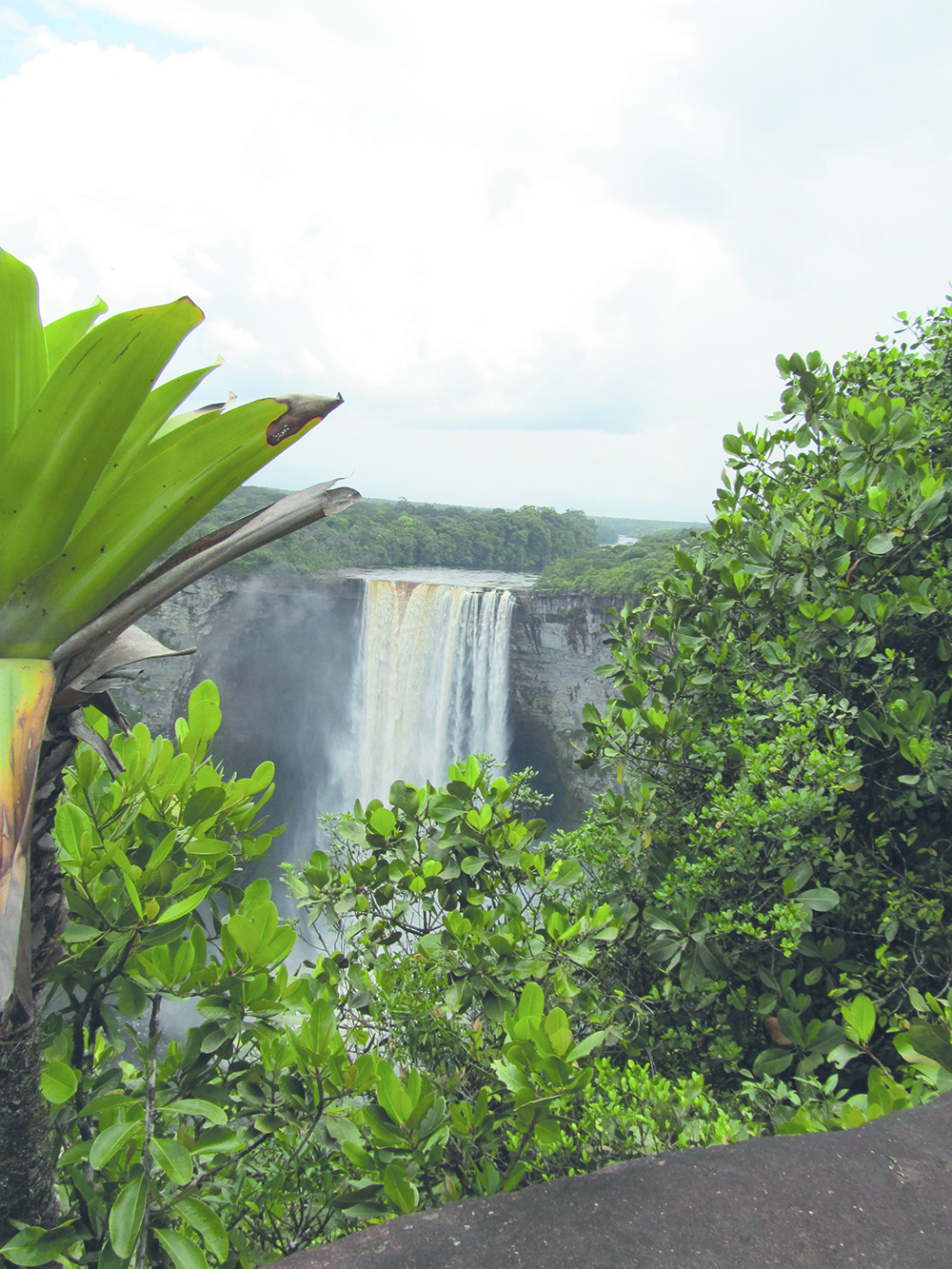
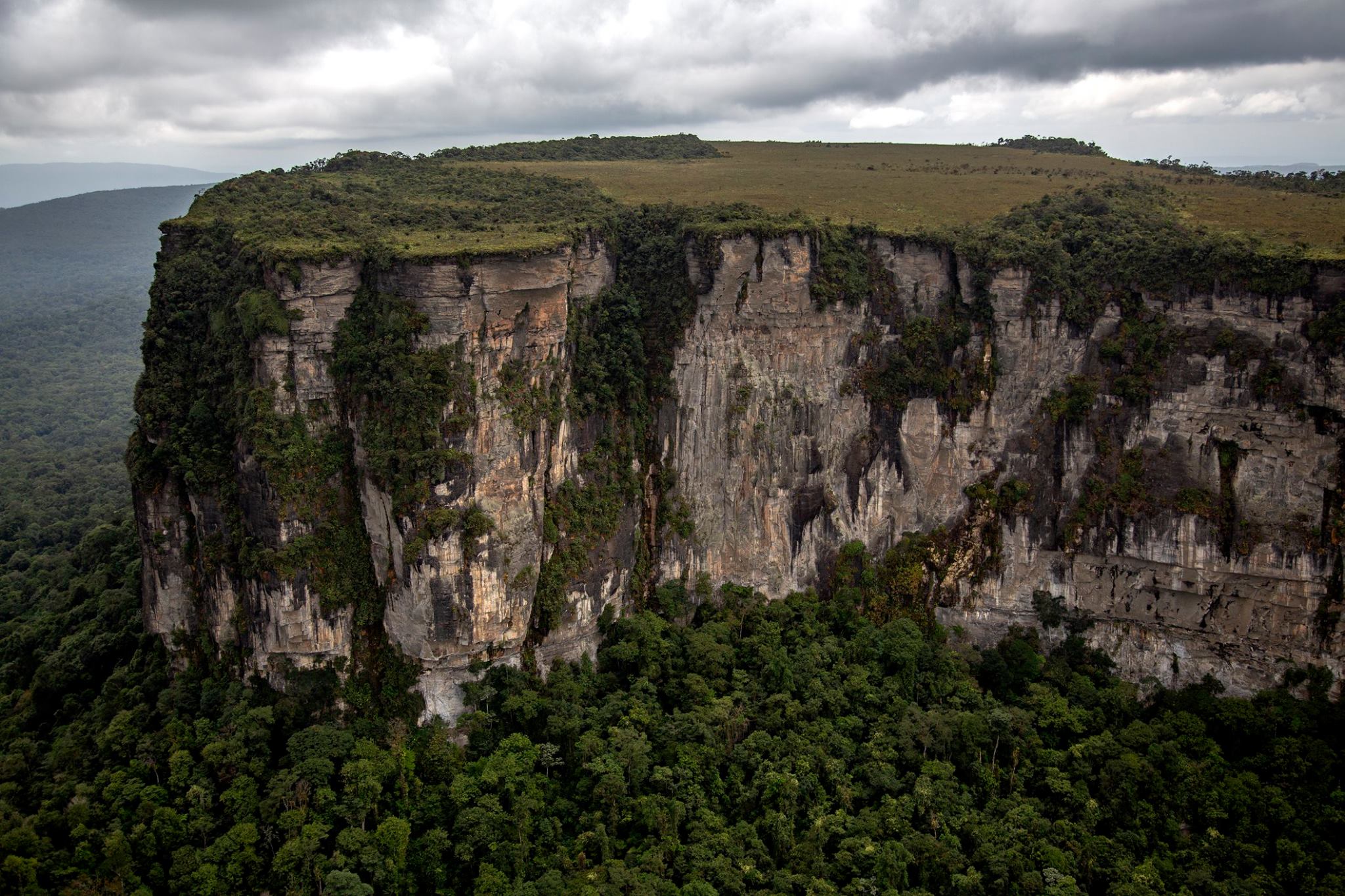
Guyana boasts an irresistible combination of fascinating and breathtaking natural beauty, pristine rainforests, immense waterfalls, and amazing wildlife, blended with a vibrant indigenous culture and diverse rich heritages.
Matt Hallett, a graduate student of the Miami University’s Institute for the Environment and Sustainability (IES), considers himself very honoured to see this natural beauty on a daily basis. Matt is continuously researching and exploring Guyana’s biodiversity for many years. He is also an affiliate of the Rupununi Learners Inc. and has been volunteering his time and knowledge towards returning the favour to the communities of the region’s indigenous villages.
His recent project is to document the number of jaguars in the richly diverse Kanuku Mountains Protected Area, by setting up remotely triggered cameras in Guyana’s deep jungle, hoping to catch the elusive big cat on film.
Matt has also been photographing scenic areas, rarely visited, in the Rupununi region. Guyana Times Sunday Magazine features this week a few of his breathtaking photos taken on his recent trips into Guyana’s jungle.
For more information on Matt’s projects, visit Rupununi Learners on Facebook.

A cool evening near Sand Creek village, Rupununi

A cool evening near Sand Creek village, Rupununi

Matt stands between the majestic trunk of this very old tree in Guyana's forest

Matt stands between the majestic trunk of this very old tree in Guyana’s forest

Mapuro Falls deep in the Rupununi jungle

Mapuro Falls deep in the Rupununi jungle

On an adventure

The Clarence Mountain Nature Trail in Aranaputa, Rupununi, is an ideal adventure trip, with breath-taking views and up-close experiences with Guyana’s rich biodiversity.
The fairly steep trail climbs up the side of a mountain in the Pakaraima Mountain foothills, and is named after the man who first went there to farm. The well-maintained trail has a resting benab at the halfway point, with spectacular views.

View of Aranaputa village centre from the nature trail

View of Aranaputa village centre from the nature trail

The cabin is set in cleared land where Clarence used to farm. Some of his fruits and vegetables still grow in the area. It is a unique eco-tourism project perched 1,000 ft above the Aranaputa community, with one of the most fabulous panoramic views of the North Rupununi savannah. This eco-project is within the conservation area of the community, and is a rich biodiversity.
On a clear day, one can see Annai, Wowetta, Makarapan Mountain, the Kanuku and Pakaraima Mountains, Surama Mountain, the Rupununi River and the vast savannah that lies between them all. The trail continues to follow a dry creek bed, and it involves manoeuvring around some rocks and small boulders. Closer to the cabin, the ground begins to level a bit and the trail passes through a grove of Heliconias: flowers in all different colours.
A night at the cabin gives an incredible opportunity to see the region’s wildlife: tapirs, jaguars, monkeys and macaws.  The guest cabin caters for small groups of eight persons and multiple night stays.
For more information on the trail, contact Alphonso Forde at alphonsoforde@yahoo.com

Guyana’s rich biodiversity

Awarmie Mountain and Grass Pond, Rupununi, are two ideal locations teeming with rich biodiversity.
Awarmie Mountain, a 40-minute boat ride from the Rewa Eco-lodge, is of much importance for locals as this is where they have their sustenance farms, and they also do much of their hunting and fishing in the area.

View from Awarmie mountain, Rupununi river

View from Awarmie mountain, Rupununi river

According to “Guyana: The Bradt Travel Guide” by Kirk Smock, “there is a good path cut up to the top of the mountain but the climb can be steep in places and should be done by those confident with their level of fitness. The hike, depending on your level of fitness, will take around two hours.”
On the top of the mountain there are expansive views of the surrounding forests and winding rivers. It is one of the best jungle vistas in Guyana. The village of Rewa has built a benab on the top that can be used for overnight camping with hammocks.
Another surrounding beauty is the Grass Pond, a 15-minute hike from Rewa. It has a stunning setting of Victoria Amazonica adorning the pond.  Also, it abounds with a good population of Arapaima (reportedly the highest density in Guyana). During a late afternoon visit at the pond you may see Brown Capuchin monkey or Capybara.  Birds likely to be seen include Limpkin, Wattled Jacana, Black-collared Hawk, Green Kingfisher and Guianan Puffbird.  As dusk approaches, witness the flowers of the Victoria Amazonica bloom in all their glory.
So for your next trip, head to your local tour agents and book an adventure to the Awarmie Mountain and Grass Pond. (Photos by David Johnstone)

The Rupununi River at sunset near Rewa Village. The river runs from the Brazilian border into the Essequibo.

The Rupununi River at sunset near Rewa Village. The river runs from the Brazilian border into the Essequibo.

On top of the mountain

On top of the mountain

Festooned with the world's largest lily, Victoria Amazonica, the pond also contained the largest freshwater fish in the world, the Arapiama

Festooned with the world’s largest lily, Victoria Amazonica, the pond also contained the largest freshwater fish in the world, the Arapiama

Fishing for the ‘dinosaurs of the deep’

The village of Rewa offers an adventure of a lifetime in sports fishing. It lies at the confluence of the Rewa and Rupununi rivers which merge, flowing 100 miles downstream into the Essequibo. It is a remarkably remote and pristine corner of the eastern Amazon basin that has been explored by very few outsiders. Rewa anglers are subsistence fishermen that typically use hand lines or bow and arrows to catch their meals. That being said, they know exactly where the fish hold, and are experts at getting them to bite.

Oliver White of Costa had to use both arms to catch this 200-pound arapaima that had a girth of about 41 inches

Oliver White of Costa had to use both arms to catch this 200-pound arapaima that had a girth of about 41 inches

Those visiting the village have a chance to experience one of Guyana’s most remote villages to learn about their way of life and join them for a rare and exhilarating catch-and-release fishing expedition on the Rewa River. Rewa Eco-lodge is the only place to fly fish for one of the giant arapaima. If you are ready to challenge the Amazon jungle for the chance to fight 400 pounds of living dinosaur, you might just have what it takes to sport fish in Guyana.
Referred to as “dinosaurs of the deep,” and believed to be the sinister reincarnation of Pirarucu, the disrespectful and taunting son of an Amazon chief, the prehistoric arapaima can grow to be more than 10 feet long and can surpass 800 pounds in weight.
Arapaimas have a wide, scaly, gray body and a tapered head and though they can stay underwater for 10 to 20 minutes, they tend to remain near the water’s surface, where they hunt, and emerge often to breathe with a distinctive coughing noise.
The Amazon’s seasonal floods have become part of the arapaima’s reproductive cycle. During low-water months (February to April) arapaimas construct bottom nests and females lay eggs. Young begin to hatch as rising water levels provide them with flood conditions in which to flourish. Adult males play an unusual reproductive role by incubating tens of thousands of eggs in their mouths, guarding them aggressively and moving them when necessary.
Arapaima are not the only fishing options, but are certainly the largest, toughest and best-fighting fish you will encounter not just in Guyana, but anywhere in freshwater. These fish can jump and pretty much do whatever they want for the initial stages of the fight. They are explosive and unpredictable, and can freight-train their way around the pond, no matter how much heat you apply.
Arapaimas have changed very little in 150 million years and are considered a living fossil. They are predators and eat peacock bass, arowanas and even small land animals and birds. South America is one place in the world where arapaimas still live in the wild, and Guyana’s Rewa Village is the only place where they’ve been caught on a fly rod.
Unfortunately, arapaimas been overfished commercially and are currently a threatened species. However, in partnership with the village council at Rewa, Costa Sunglasses, USAID, Nervous Waters, and the Guyana Ministry of Agriculture, Wilderness Explorers is able to offer a limited number of sport fishing licenses for a remarkable and unique catch-and-release experience on the Rewa River.

The scales on an arapaima are surprisingly soft, and on a big one, they're about the size of a silver dollar

The scales on an arapaima are surprisingly soft, and on a big one, they’re about the size of a silver dollar

Costa Sunglasses, a U.S. group of fishing fanatics, is on a mission to protect the world’s waters by promoting sport fishing. This sport is environmentally friendly, sustainable and native to local cultures. In the rivers and ponds of Guyana’s unspoiled rainforest, Costa found a place where sport fishing can preserve the country’s natural resources and culture by supporting its indigenous peoples in a responsible way.
In a new feature film directed by Louisiana Kreutz and produced by Costa Sunglasses, “Jungle Fish” follows three fishermen on an epic voyage into the heart of Guyana’s untamed jungle. Their mission is to prove that the world’s largest freshwater fish—the arapaima—can be caught with a fly. If they succeed, it will mean a brighter future for the Amerindians, the rainforest they call home—and for the threatened arapaima itself.
For more information on the documentary visit wilderness www.costadelmar.com. For details on the sport fishing adventure, visit www.wilderness-explorers.com. (Photos by Costa)

Bourda Market Experience Guyana’s dynamic commercial hub

Bourda Market was originally built in 1880, and reconstructed in 1902 to accommodate a growing number of vendors and consumers of this ward of the city. Today, according to the National Trust, this market is the focal point for many commercial activities in the city.

Evening shopping

Evening shopping

This ward of the city’s was derived from Joseph Bourda who purchased this area, which later became his estate. In 1876, this ward was reorganised by the Vlissingen Commissioners who were appointed by the government to analyze the claims made by many persons to be the heir of Joseph Bourda.


An array of fruits

An array of fruits

Today, many visitors enjoy walking through the numerous makeshift stalls shopping the variety of fresh fruits, vegetables, and meats. Night shopping experience is also an adventure as many wade through the walkways in the square in search of deals on local fruits and vegetables.
For tourists, visiting the more than 100-year-old market will require a change in terms when asking for certain vegetables. If you go around asking for eggplant, many will look at you with a blank stare. Instead, ask for “bulanjay” (bu-lan-jay). Instead of “avocado”, ask for “pears”, “channa” not “chickpeas”, “callaloo” not “spinach”, and “Pak Choi” not “Bok Choy”.
Bourda Market is the ideal shopping hub for anyone who wants to eat healthy on an affordable budget and enjoy diversity.

A sports Fishing Paradise British angler catches monster fish in Guyana

Now here is a bountiful catch. According to the Orange News, British angler Steve Townson achieved his dream of catching a giant, wild arapaima fish in Guyana.
The wild arapaima is the largest freshwater fish in the world, and Townson’s massive catch, plucked from the Essequibo River, weighed more than 250 lbs.

The monster fish caught by Townson (right)

The monster fish caught by Townson (right)

Townson achieved his fishy feat by using a 2-lb piranha as bait. The angler has travelled the world, especially South America, hooking exotic and unusual fish for a living. He has even started a company to help others do the same, calling it “Amazon Angler”.


Checking out the features of Guyana's peacock bass

Checking out the features of Guyana’s peacock bass

After posing for photos, Townson allowed the fish to be released back into the water.
“The Arapaima is one of the world’s biggest and mightiest freshwater fish, and to catch them in the wild is a rare privilege,” Townson shared with Orange News. “They are protected and cannot be removed by law for the table, but our partners in Guyana are working on strictly catch-and-release, with the local Amerindians.”
Townson assured animal lovers that the fish was never removed from the water during the catch. Since the behemoths are actually quite fragile, the angler handled the arapaima with care and then let it swim away “to fight another day.”
A 339-lb arapaima caught recently by a different angler holds the current record for biggest arapaima caught.


The 2-lb piranha used as bait

The 2-lb piranha used as bait

Now that Towson has crossed this goal off the list, he hopes to bring the same experience to others. The angler is looking to start trips to the river for supervised arapaima catching. (Source: PawNation)

Amazing Guyana

Views from above capture the coastland’s beauty

The beauty of Guyana’s vast interior is renowned, but this week Guyanese photographer John Greene shares his spectacular aerial shots of Guyana’s beautiful coastal landscape with Guyana Times International.

The beauty of the Botanical Gardens

The beauty of the Botanical Gardens

Wonderful view of the Demerara Harbour Bridge

Wonderful view of the Demerara Harbour Bridge

Spectacular shot of Stabroek Market

Spectacular shot of Stabroek Market

A horseback journey to Guyana’s petroglyphs trail

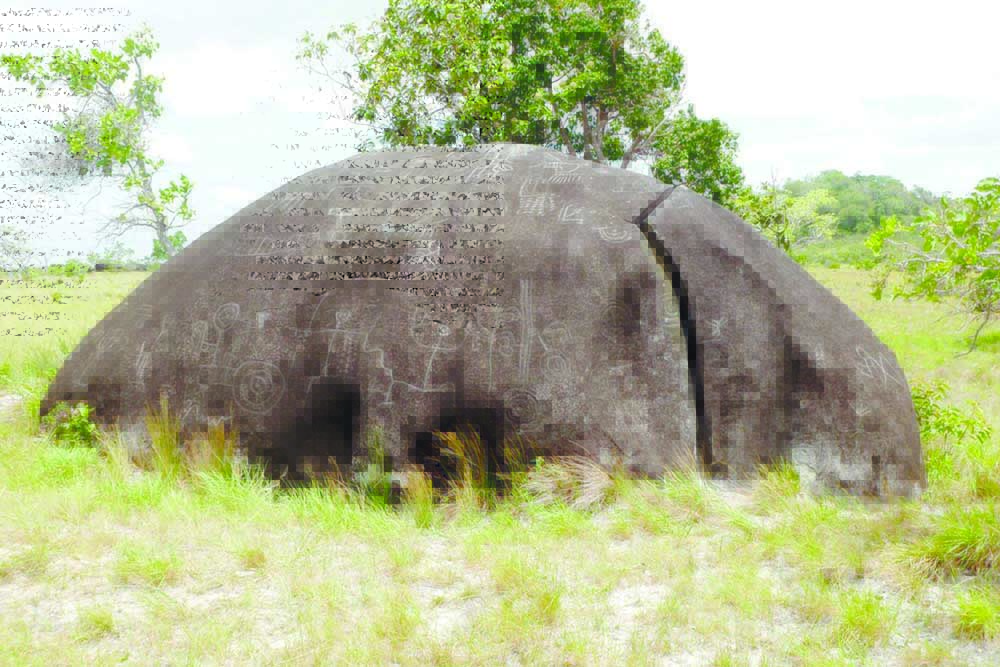
A horseback journey to Guyana’s petroglyphs is a unique tour that combines the romantic adventure of horse riding on the open savannahs and the fascinating study of Amerindian petroglyphs. Some of the ‘Fish Trap’ petroglyphs date back 4,000 years to a warmer climatic period. Their stories suggest a resource control plan by the Amerindians indicating what type of fish strategies should be employed at each site.

Wonderful view on the way to the trail

Wonderful view on the way to the trail

Dadanawa Ranch

Dadanawa Ranch

The journey begins by plane to Lethem then taking a jeep across the savannahs to Dadanawa Ranch, the largest ranch in Guyana, where you are acquainted with your horse and gear. The ride across the vast savannahs, through bush islands and crossing creeks, leads to the foothills of the Kanuku Mountains and the village of Sand Creek. Close by is the Rupununi River, which provides welcome respite after the 15-mile ride.
The journey continues to the remote Werimur Ranch where you can explore the edge of the rainforest or pan for gold in the creek. Riding through the savannahs to the village of Rupunau will reveal rocks with petroglyphs. At Wiwi Tau, a large rock several hundred feet high has a cave with ancient carvings.

Beautiful view of Sand Creek

Beautiful view of Sand Creek

The journey continues to Shea Rock, which offers fantastic views at dawn over the plains and, on a clear day, you can even see Dadanawa’s ranch houses. The last morning of riding starts before dawn to beat the heat of the day for the final ride back to Dadanawa Ranch. Back at the ranch there is time to rest weary bones and enjoy the lifestyle of the vaqueros. The final evening is celebrated with a Rupununi style barbecue and famous Guyanese rum. (Information by wilderness-explorers.com)

Monster fish surgery in the wilds of Guyana

As the sun rises on the Rewa River, I wake to the sounds of howler monkeys rambling in the trees and a cacophony of tropical birds with their joyful noises. I pause for a moment and ponder the drastic difference between this and the wake-up calls of the bustling city of Chicago, where I live: police and fire truck sirens blaring in the streets, buses making their daily routes and anxious drivers blowing their horns as they navigate traffic. I welcome the change and feel a stream of excitement, as these are the sounds of my new home here.

Holding onto a radio-tagged arapaima

Holding onto a radio-tagged arapaima

After coffee overlooking the river, my field assistant Liz Smith and I walk to the home of the village leader, or Toshao, to discuss the details of the research. Welcoming us under a mango tree, the Toshao expresses his excitement at our being the first researchers to base out of Rewa Village for an extended project like this. Likewise, it is difficult to conceal my excitement for the opportunity to work on the river, where villagers have been on the forefront of conservation efforts for arapaima and other local wildlife.
Our conversation leads into a discussion of the unknown in pioneering something in research. To my or the Toshao’s knowledge, no study has ever implanted arapaima with radio transmitters for telemetry. I find myself anxious and excited, but mostly encouraged by the Toshao’s support of my research.
In the afternoon I receive word from Georgetown that the net I need to continue my project is stuck in customs. My net was custom-made for arapaima; it is 250 feet long and weighs more than 200 pounds, and has apparently raised some eyebrows in the customs office. The net is critical to the success of the project, and I shipped it several weeks in advance to ensure it would be here upon my arrival. My experience from prior expeditions is that logistical challenges are an expected companion on every trip. I remain optimistic that it is a minor issue and talk to villagers to orchestrate a different method for catching arapaima, which can reach lengths of nearly 10 feet and weigh more than 440 pounds, in the meantime. What we couldn’t catch with an impounded net, we would try with an available rod.
The next morning, Liz and I join Rovin Alvin, one of Rewa’s best fishermen, and two other fishermen for a trip to a nearby pond to find arapaima. The sun has barely illuminated the sky as we paddle the short narrow stretch that opens into a large pond. I gaze across the glassy surface as it mirrors a perfect reflection of the shoreline and the sky. An arapaima rolls, disturbing the perfect stillness and the normal pace of my heart. The angler’s cast has an immediate effect. The line buzzes furiously out of the reel as the fish bolts across the pond. The arapaima leaps into the air, and I see for the first time the magnitude of the fish I will somehow have to handle.
The angler continues working and my mind begins to race. I realize just how enormous this fish really is.
Amerindian guides instruct the angler to get the arapaima closer to the boat so it can be handled and I can insert a radio transmitter. As the fisherman draws the arapaima closer, Liz prepares the surgical equipment. With a deep breath, I force myself to rise above my nervous energy and jump into the water. Despite being tired, the arapaima releases a thunderous kick creating a wave underwater with enough force that I stop to secure my footing. Rovin and two other strong Amerindian men jump into the water and hold the arapaima.
They turn its belly upward so I can perform the surgery. To begin, I remove several scales. Quickly, I make an incision, insert the radio transmitter and begin suturing. As I finish the suture, the arapaima releases one last kick. I secure the incision with tissue glue and we take final measurements. The arapaima gulps air as Rovin and I gently release it back into the pond.
Completely exhausted by the intensity of what just happened, I submerse myself underwater for a few long seconds. This is certainly one of the more surreal moments of my life. Handling one of these creatures is like stepping back in time to swim amongst dinosaurs. (By Dr. Lesley de Souza. First published in New York Times under ‘Science at Work’ blog)
Dr. Lesley de Souza, a research biologist at the John G. Shedd Aquarium, writes from Guyana, where she studies the region’s rich aquatic wildlife, including the arapaima, one of the largest freshwater fishes in the world.

Guyana’s most beautiful gardens

Breezy walkway in the Botanical Gardens

Breezy walkway in the Botanical Gardens

No trip to Georgetown would be complete without visiting two of Guyana’s most beautiful gardens: the Botanical and Promenade Gardens.
The Botanical Gardens was established in 1878 and is one of the treasures of the city, and indeed the country. The Gardens is laid out on one hundred and eighty five (185) acres of land on Plantation Vlissengen (an abandoned sugar estate).
As you stroll through the Gardens, you not only have an opportunity of viewing the exceptional plant collection, but also spectacular butterflies, intriguing birds and even the endangered West Indian Manatee.
Within the Gardens there is a vast array of tropical flowers, fruits, and plants; some of which are of cultural significance. It was believed that at one time more than 100 species and 50 genera of palm trees from around the world were cultivated in the Gardens. Today although palm trees still dominate the grounds, they are not to such an extent.

Aerial view of the Promenade Gardens

Aerial view of the Promenade Gardens

Other tropical trees that can be found within the Gardens include the Monkey Pot Species, the Saman, the Jacaranda and the night blooming Water Chestnut (Pachira aquatic).  At the Botanical Gardens, every plant and tree has a story of its own. So come and discover our beautiful Botanical Gardens.
The Promenade Garden, with its main entrance on Middle Street, occupies one city block. In August 1851, the Town Council made a decision to create a public promenade for the relaxation of the public.  Housed   in    the   compound of the gardens are several monuments such as the bandstand, the oldest in the city and   the    statue   of    Mahatma Ghandi. A range of flora complements the surreal surroundings.
Along with several fountains and an arched walkway, a recent construction in the Gardens, is the Arya Samaj Monument erected in 2011.
It has been suggested that the Promenade Gardens at one time boasted the largest range of wild orchids in the Caribbean before it fell into disrepair during the 80s and 90s.
The site was rehabilitated in 2006 and the Bandstand refurbished by Republic Bank in 2009.
In its earlier years the Promenade Gardens was used for several civic functions, including entertainment from music bands; today, after refurbishment, it remains the site of many public and private events, including the popular annual Inner Wheel Club’s Easter Hat Show, weddings, and fashion photo shoots to name a few.

Indian Arrival Monument in the Promenade Gardens

Indian Arrival Monument in the Promenade Gardens

Botanical Gardens Bandstand

Botanical Gardens Bandstand

One of the 'kissing bridges' in the Botanical Gardens

One of the ‘kissing bridges’ in the Botanical Gardens